Sunday, October 25, 2015

Leaf Serving Pieces II: Tiles/Trivets


Six-inch Silver Maple
Tile/Trivet
Back when I first started making Spoon Rests, I also made complementary Tiles/Trivets to go with them. These were flat pieces with embossed leaves - like the Spoon Rests -  that could either be used flat to protect your table from a hot or damp dish or hung on the wall as a decoration. (As I've said for years, I grew up with a very rigid and controlling family; I'm still rebelling by being as versatile and flexible in my art as possible....) When I first started making these, since I had not yet taken a tile class and so had not learned how to make and use tile molds, I would work directly from a clay slab.

Six-inch Eastern Redbud
Tile/Trivet
Rolling out a half-inch-thick slab of clay on the slab roller, I would scrape the canvas texture away with the flat side of a metal kidney (sometimes following this up with a quick roll with my rolling pin), place a leaf (vein side down on the clay - this is very important) on the smooth surface and roll the leaf into it. Using my six-inch tile cutter, I'd cut around the leaf to make the tile/trivet.
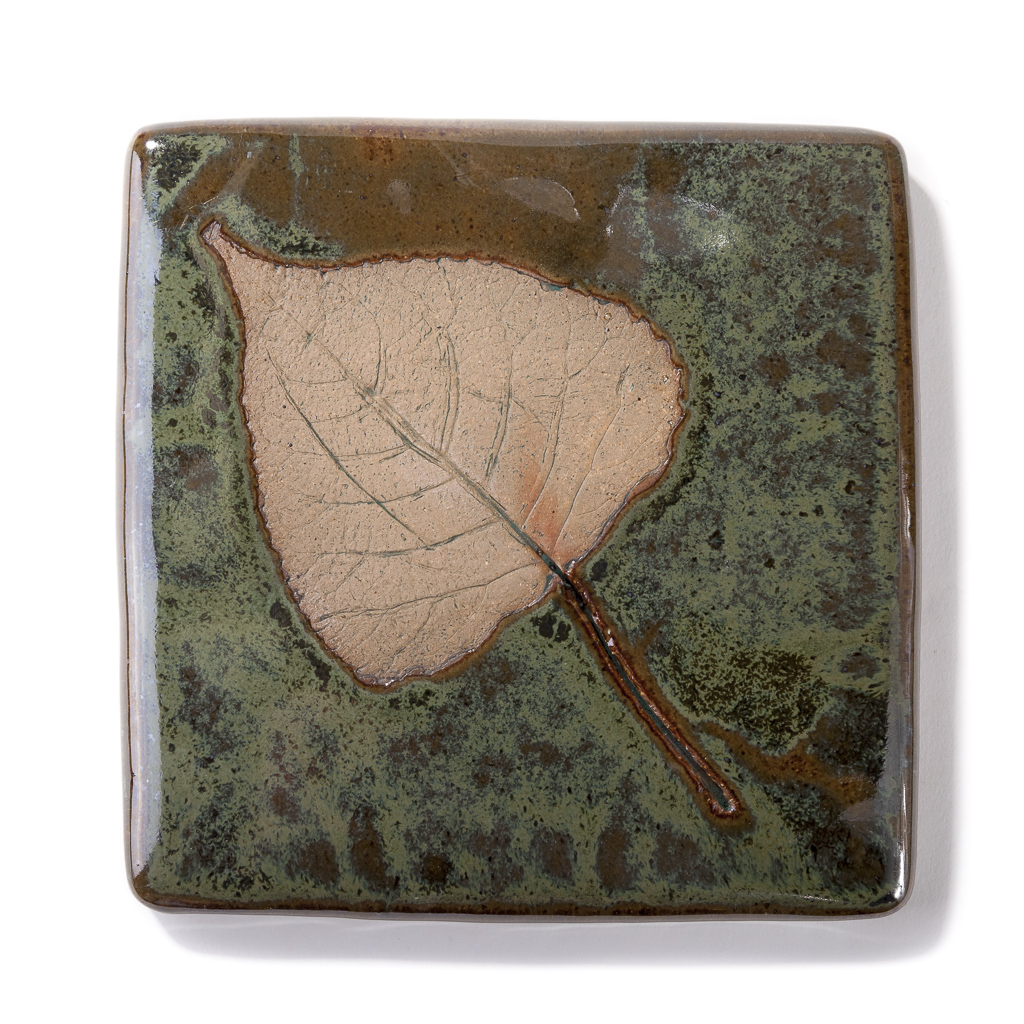
Six-inch Eastern Cottonwood
Tile/Trivet

The difficulty was getting a good clean release from the tile cutter. All too often, the clay would stick on part of the device and release unevenly, warping the tile/trivet in the process. Since I hadn't learned about using scrap drywall to dry my flat pieces more evenly (even stacking dry wall with more tiles or other work on top, in a tower of tiles and other pottery), the warping might not be corrected as the piece dried and was bisque and glaze fired; clay has memory and, sometimes, it can be pretty tenacious. I sold quite a few of those pieces - both individually and in sets with a spoon rest - but I was never completely happy with them. I finally stopped making them.
Eight-inch Northern Catalpa
Tile/Trivet

Fast forward a few years and my Hanging Bird Bowls have evolved into, among other things, Applied Leaf Bowls and, earlier this year, Applied Leaf Trays. (I'll be doing posts on those shortly.) On the advice of my mentor, I decided to put additional pieces to assemble a comprehensive series for serving use at the dining or buffet table. Reviving the Spoon Rests and Trivets seemed obvious.

Eight-inch Common Witch-hazel
Tile/Trivet
In the interim, I had taken a tile-making class with David McGee at Pewabic Pottery. (David is an excellent instructor as well as a uniquely talented artist in his own right. I would encourage anyone interested in learning about pottery in general or in tile making specifically to take at least one class with him.) I learned how to design master tiles as well as how to make molds of those masters in order to take a design into production.

Eight-inch White Oak
Tile/Trivet
The challenge with these sorts of leaf designs is that, if you were to make a mold of an embossed leaf tile, the design is so subtle and has so little relief that, in pounding out the tile, you get "echoes" of the leaf rather than a clear image, which doesn't make for a particularly satisfying design. So, I've made a blank master mold and place a leaf into the mold (in this case, vein side up so it will be against the clay surface) each time I make a piece. The down side is that, for some leaves, you can only get one impression; the up side is that, even if you can re-use the leaf, each piece is unique as recreating the exact placement is essentially impossible. I insert hanging divots in three places in the back of the Tile/Trivet so the leaf can hang either square (with the leaf's tip pointing to the upper right or the upper left) or as a diamond (with the leaf tip pointing upward).

Once dried, cleaned up and bisque fired, the pieces are finished in my typical fashion, using a water-based stain on the leaf and drawing the excess off with a damp sponge to bring up the veins. Wax resist is applied to the leaf (I also use it on the backs of my tiles - it's just easier for me to do that rather than clean off glaze) and allowed to cure. I then glaze the piece, wiping the edges so they don't drip. I fire to Cone 6 with a 40-minute hold. The Tiles/Trivets are food safe and heatproof.

Sunday, October 18, 2015

Leaf Serving Pieces I: Spoon Rest

Silver Maple Spoon Rest
It's been almost a year-and-a-half since my last post. My apologies for my long-term absence; it's been a tough time but I'm starting to get back to my normal. So, I thought I'd just plunge back in and start with a blog post. Finally.

Northern Catalpa Spoon Rest
I've been working on a series of pieces for a wholesale website and, in the process, returning to some (very) old designs as well as taking some more recent ones to a new level. I've been developing a collection of serving pieces based on my Applied Leaf Bowls and, in that context, revisiting some pieces I had stopped producing, having realized they worked well with my new direction.

Eastern Redbud Spoon Rest
Common Witch-hazel Spoon Rest
The spoon rests are one of my earliest leaf pieces, inspired by my friend Rebecca who asked for something she could use on her stovetop. I had been using leaves fired with a stain to bring up the texture of the veins but she wanted something with some glaze and a more consistent shape. I came up with a pie-piece (actually, about 120 degrees, or a third of a circle) that I formed it into one of my small bowl molds, embossed a leaf into it and added a small clay branch. The key is to make sure any canvas texture is smoothed away from the surface before embossing the leaf; emboss the leaf with a smooth stone rather than a sponge, which would pull clay away from the surface and not push the leaf into the clay surface consistently.
Eastern Cottonwood Spoon Rest

After drying, the piece is cleaned up (synthetic steel wool is great for this; I save the accumulated clay dust and recycle it with the rest of my waste clay) and bisque fired to Cone 04 or 06.

White Oak Spoon Rest
Glazing follows the same process I use for all of my leaf and branch pieces. I use burnt umber solution to stain the branch, pulling the excess away with a damp sponge. Then I stain the leaf (I have a "key" I've developed that tells me which stain and glaze combination is used with a given type of leaf) and, again, pull the excess away with a damp sponge to bring up the leaf's veins. Both surfaces are treated with wax resist and, after curing for several hours, dipped in the appropriate glaze. I fire on stilts to Cone 6 with a 40-minute hold.

Although designed as spoon rests, they also work as soap dishes, change stashes, jewelry dishes, tea-bag rests and candle holders. All are food safe and can go in the dishwasher.


Sunday, May 18, 2014

The Beauties of Belle Isle

A colony of White Trout Lily
(Erythronium albidum)
As a Detroiter, Belle Isle is probably one of the most underrated resources we have here in the city. Almost a resort in its heyday, the island has fallen into disrepair, a circumstance exacerbated by the city's own woes. Recently, it has come under the aegis of state government, which will, hopefully, herald the island's resurgence as a go-to destination - not just for city folk but for all Michigan residents and beyond.

Native Violet (Viola) species
I first really started to get to know the island when my Master Gardener organization (the now-defunct Master Gardeners of Greater Detroit, or "MGGD") used to have their monthly meetings at what used to be referred to as The Belle Isle Nature Center (now known as the Belle Isle Nature Zoo, affiliated with the Detroit Zoo). I also volunteered there for the annual Belle Isle "HUG" ("Help Uncover the Gem") with The Greening of Detroit, planting trees - many of them young saplings grown from seed gathered on the island by naturalist Suzan Campbell.

Cut-leaf Toothwort
(Dentaria laciniata)
Through MGGD, I went on my first Spring Wildflower Walk in a small part of the island near the racquet ball courts - led by Terry Light - in 2005. Nine years later, I led my first wildflower walk for the Detroit Garden Center, in an event the non-profit organization plans to sponsor on an annual basis - and perhaps more frequently, to see the changing of the seasons in this unique habitat. A few days later, I enticed my photographer friend, Don Schulte, for a visit; these photographs are the fruits of that excursion.

Amongst the islands' residents is a small herd of European Fallow Deer - members of an introduced exotic species who had, over time, adapted to the 985-acre park by mutating into a smaller animal. The deer roamed freely over the island, leading to over-browsing and a significant reduction floral species health. In 2004, the deer were penned up; horticulturalists, naturalists and native plant enthusiasts were amazed come 2005 to see the plethora of native plant species that had survived the deers' depredations.

White Trout Lily
(Erythronium albidum)
Singularly, the rare White Trout Lily (Erythronium albidum) was - and continues to be - one of the stars of the show. Less common than its cousin, Yellow Trout Lily (Erythronium americanum), other common names include White Fawn Lily, Dog-tooth Violet and Adder's Tongue. The first two - "Trout Lily" and "Fawn Lily", refer to the speckled leaves, resembling the speckling on native trout or an immature deer. "Dog Tooth Violet" refers to the shape taken by the plant's bulb, which resembles a canine tooth. Finally, after the plant has gone to seed, the pistil still protrudes beyond the seed head, looking like a snake's head with the tongue sticking out.

The Trout Lilies are Spring ephemerals, as are our native Trillium (Trillium spp.), Bloodroot (Sanguinaria spp.), Shooting Star (Dodecatheon spp.) and other woodland natives. Like Mayapple (Podophyllum peltatum), only plants with two leaves will flower; plants with only one leaf do not have sufficient photosynthesis potential to survive the expense of flowering and fruiting. These plants also have a tendency to pull themselves deeper into the ground over time, reducing their flowering potential as greater and greater energy is expended in simply getting above ground; this behavior can be overcome by setting a flat piece of stone eight to twelve inches below grade and then planting above it.

Spring Cress
(Cardamine bulbosa) flowers
Don and I weren't able to do the entire walk. In fact, all of these photos were taken within less than a 50-foot stretch of the entire walk. Other forbs (herbaceous plants that are neither grasses nor ferns) we found included Cutleaf Toothwort (Dentaria laciniata) and what was, at the time, a mystery plant which turned out to be Spring Cress
(Cardamine bulbosa), two members of the cabbage family.

Spring Cress
(Cardamine bulbosa) in situ
Both have delicate, pink, four-petaled flowers - more usually white in both species. The foliage is very different, however, with the Toothwort characterized by strongly dissected leaves arranged around the stem while the Cress has shallowly-palmate leaves arranged oppositely along the stem.

Interestingly, the Toothwort seems more tolerant of drier conditions, finding a home in high, dry areas of the woods, while the Cress prefers low places with Spring inundation. Belle Isle is part of a threatened environment known as "Lake Plain Prairie" - low areas characterized Spring flooding, or "vernal pooling", which dries out with the onset of summer. Plants have evolved various strategies to cope with these circumstances, from heavily-buttressed tree roots to maintain stability in soft Spring soils to ephemerality to take advantage of early season moisture, followed by dry-season dormancy. Many are able to tolerate low-moisture conditions for long periods of time as well.

Spicebush (Lindera benzoin)
Spicebush (Lindera benzoin) is particularly well suited to this environment, such that I often recommend it to clients who experience Spring flooding in their yards. This early season bloomer displays tiny yellow flowers. Like both native and exotic holly species, Spicebush is dioecious, meaning that there are female and male plants and both are required to obtain fruit. Unfortunately, as this plant is not as popular in the trade, it isn't always easy to tell which plants are which; your best bet is to shop in the fall and look for plants with fruit - as those are definitely female; as for those without fruit, you'll have a 50-50 chance it will be male. As with holly, you don't need a one-to-one ratio of male to female - one-to-four should be sufficient - but the plants cannot be too far from one another, so your pollinators can get the job done easily. Its common name derived from the plant's spicy scent (scratch a small area of the bark and take a breath), Spicebush is also one of the larval host plants of the beautiful Spicebush Swallowtail Butterfly (Papilio troilus), the other being Sassafras (Sassafras albidum).

American Black Currant
(Ribes americanum)
Other shrubs in the area include Drummond's Dogwood (Cornus drummondii), a small deciduous tree found on the Great Plains and along the Mississippi as well as the Midwest. Blooming in Summer with clusters of white flowers, similar to those found in the Spring-blooming Redtwig Dogwood (Cornus sericea), it bears small white fruits that ripen August to October, fruits that are utilized by at leasts 40 native bird species. When we visited, this plant was just starting to leaf out but a visit later in the season may favor us with the floral display.

Another important fruit-bearing plant is the American Black Currant (Ribes americanum), which was blooming when we visited the island. Like Spicebush, the flowers are quite tiny and greenish yellow. A member of the gooseberry family, these are small shrubs - up to 4-1/2' in height. The fruits - which make outstanding jams and jellies - are also utilized by native avian species as a desirable food source.

Native Violet (Viola) species
Scattered along the walk were numerous colonies of native violets, similarly-hued but much more desirable than the spreading invasions of Periwinkle (Vinca minor) we saw. Although violets aren't particularly popular with many gardeners, this is generally due to the aggressive, large-leaved, purple-flowering violet despaired of by so many of us. But there are numerous, lovely native violets, including Downy Yellow Violet (Voila pubescens), Canadian White Violet (Viola canadensis), Long-spurred Violet (Viola rostrata) and Common Blue Violet (Viola sororia), which provided a cheerful highlight along - and even in - the asphalt walkway. Despite our mixed reactions to them, Violets are important host plants for native Fritillary butterflies, so their value in the native garden should not be minimized.

Jack-in-the-Pulpit
(Arisaema triphyllum)
Finally, our perennial favorite - Jack-in-the-Pulpit. This native member of the Aroid family - like Eastern Skunk Cabbage (Symplocarpus foetidus) and Green Dragon (Arisaema dracontium) has been in decline along this stretch of the island; whereas nine years ago we saw numerous colonies of many individuals, this year they were much fewer and farther between. It is certain that, as the years pass and effects of the deer continue to abate, the environment will evolve. What used to be primarily large trees and open spaces now has a great deal of shrub cover, mitigating the amount of sunlight reaching the ground and these woodland plants. The effects of the Emerald Ash Borer (Agrilus planipennis) are also visible, with many more snags and downed trees, making passage through parts of the area difficult if not treacherous.

Each year, the environment continues to change, with the ebb and flow of the seasons and the continuing impact of human activity on the island.

All photos copyright to Don Schulte and Notable Greetings.

Saturday, April 5, 2014

Spring Is Sprung

I was recently given authorization to write another article on native plants for Michigan Gardener Magazine. By way of some backstory here, I wrote the first article on native plants to appear in that publication back in May 2012; I penned an article on non-vining Clematis for the 2013 season and have articles on combining natives and exotics and on invasive Phragmites on deck for 2014. The third article for 2014 takes as its topic the various strategies plants have evolved for "getting around" - maximizing genetic diversity through various seed-dispersal technologies.

Most of the plants I took for examples exist in my home garden on Detroit's east side. These was one plant, however, that I had tried to grow (as yet) unsuccessfully that I wanted to discuss - Eastern Skunk Cabbage (Symploycarpus foetidus), a plant with very specific, difficult to replicate, cultural needs. Not surprisingly, this plant is not something you just "happen upon" on a casual stroll through your neighborhood.

Why would I want to grow this plant? Well, there are lots of reasons. First, I've become something of an obsessive native plant "collector" - partly for my own satisfaction but also in an effort to introduce as many people as I can to as many native plants as I can at my semi-annual garden tours - everything from native Michigan Eastern Prickly-Pear Cactus to water-loving Marsh Marigold. Plus, I'm not one to shrink from a horticultural challenge - and growing Skunk Cabbage is challenging. And then there's the idea of having a "zoo" garden - a garden of plants with animal names - including Cardinal Flower (Lobelia cardinalis), Turtlehead (Chelone glabra), Fox Sedge (Carex vulpinoidea) and Goat's Rue (Tephrosia virginiana), among many, many others. (I may do a post on those yet!) Plus, it's one of the coolest plants you'll ever see.

Cool? How could a plant called "Skunk Cabbage" be cool? Well, one of the very "coolest" things about Eastern Skunk Cabbage is that, through a chemical reaction, it is able to generate temperatures of up to 95ºF warmer than the surrounding atmosphere, making it one of a very few plants capable of thermogenesis (creating its own heat). It isn't unusual to see the plant's clumps emerging right up out of the snow as it creates little "islands" of heat.

Eastern Skunk Cabbage is one of five species within its genus. Although both are members of the Aroid family, Western, or Yellow, Skunk Cabbage (Lysichiton americanus) is of a different genus. (Both genera have species native to North America and Asia.) Its nearest relatives in Michigan include Green Dragon (Arisaema dracontium) and the ever-popular Jack-in-the-Pulpit (Arisaema triphyllum).

The first part of the common name, as well as the second part of its Botanical Latin name, refers to the plant's strong musty odor (especially noticeable when the plant is crushed), which attracts early-season pollinators, including flies, stoneflies and bees; the scent may also discourage larger animals from disturbing it. The leaves, which are quite cabbage-like, emerge after the plant has flowered.

The flowering bodies of all members of the Aroid family (referred to as "Araceae") - including such floral favorites as the Peace Lily (Spathiphyllum cochlearispathum), Calla Lily (Zantedeschia æthiopica) and Anthurium spp.  - consist of two parts: the "spathe" - a large bract forming a sheath - around the "spadix", or flower cluster, which actually contains the plant's reproductive parts. The spathe (note the Botanical Latin name for Peace Lily, in which both the genus and epithet contain forms of the word "spathe") protects the reproductive parts of the plant from the elements, assisting in more successful pollination. The heat generated by the plant may also help better spread its distinctive odor while making for an attractively warm haven for any passing pollinators.

Like the Jack-in-the-Pulpit, there is quite a bit of variation in the spathe's coloring, although it is always a combination of burgundy and mustard yellow. More frequently mostly burgundy, the balance between the two colors varies widely, even within a single clump.

Eastern Skunk Cabbage is a wet-land obligate - meaning that it must have wetland conditions to survive. It does like a certain amount of sun and benefits from late winter/early spring exposure in deciduous woods, when there is little leaf cover while it flowers. It also has contractile roots, which actually pull the plant further into the ground as it grows - so the crown is always at the surface while the root system drives down further into the soil, making it difficult - if not impossible - to transplant.

Seeds are born in a club-like structure, most of which eventually rots away, leaving the seeds to fall into the surrounding mud to be dispersed by animals or seasonal flooding.

When I first decided to include this plant in my article on seed dispersal, the first issue was finding someplace to photograph it. I contacted a number of folks in my native plant network who suggested a number of possible locations, including Seven Ponds Nature Center in Dryden, Michigan. My photographer, Don, and I took a drive up that way on April 2 and found a sizable colony in full bloom behind the main building. Some clumps were still surrounded by snow and the ground, though beginning to thaw, was still fairly firm.

We spent the better part of two hours out there - despite dropping temperatures, increasing cloud cover and rising winds. (One very good thing about photographing this plant: no matter how windy, it stays perfectly still!) We took numerous frames - Don calling the shots; I assisting in whatever ways I could. Finally, my hands started getting blue (I had left my jacket in the car as it seemed pretty nice out when we left the parking area!), so Don gave me his jacket. We found the plants utterly captivating, finding one vignette after another to further "explicate" this unusual plant, capturing each blossom's unique form, the transition of the seasons around us and the complexity of the natural community in which they exist.

I'm now thinking of ways to recreate these beautiful forms in clay, from the jug-like spathe and complex spadix to the subtle shading of burgundy and mustard yellow. I also hope we'll have the opportunity to further document its annual cycle later this season.

Pillow Vases V: Sea Urchin

Techniques for applying the decoration can vary. When possible, I score and slip the vase's surface - this works quite well with the "Frosted" design because the decoration is always located around the opening and at the vase's "waist". (I use a large round cookie cutter to plot the line of decoration on the tiny vases with multiple openings.)

Since I have learned that scoring marks not covered by decorative elements can still be visible after glaze firing, I score and slip the underside of the decorative elements of the "Scrolls" and "Rosettes" designs instead. Due to the size and arrangement of the elements for the "Sea Urchin" designs, making sure the vase is plastic enough to take the decoration and then gently pressing it on after it has hardened somewhat seems to help prevent separation. There is no applied decoration for the "Lace" or "Plain" vases so the issue is moot for those designs. I then set the pieces to dry slowly before the final preparation for bisque firing.

Once I find a technique that works for me, I tend to push them as far as I can to see what else I can do. In terms of the slip-filled pastry bag, that was expressed in investigating as many different workable decorating tips as I could.

Not all of them work very well, but I did find that the plain round tips (of various sizes) and the ribbon tips are pretty useful. I use a medium to large round tip for these Sea Urchin vases, so called because the decoration resembles the surface of a sea urchin. I start off with a circle of "dots" of slip placed evenly around the opening, then another, larger, circle of dots, alternating between each of the dots in the first row, continuing to alternate down to the vase's "waist". (Vessels have "anatomy" which relates back to human physiology - with "necks", "shoulders", "waists" and "feet".)

Sunday, March 16, 2014

Pillow Vases IV: Frosted

One of my favorite decorating tools in the studio is a pastry bag filled with slip with any one of the various decorating tips I've purchased over the years. I found my first "set" of decorating tools at K-Mart, when Martha Stewart still had a relationship with them - the kit I purchased (in a very nice lidded metal box) had her name on it. Since then, I've scoured cake decorating aisles at Michaels and JoAnne's for new and exciting effects. I find myself most often using star, round (of various sizes) and ribbon tips for my projects. The "Frosted" Pillow Vase designs are made using a "star" tip.

After assembling the Pillow Vase vessel form, it's often too dry to decorate right away. If that's the case, I can either re-hydrate it by draping with a damp rag and placing in a plastic bag or brush the surface with slip intermittently before adding the decoration. Once the piece is moist enough to successfully accept the decoration - moist but not so plastic that the clay will buckle at all with any pressure), I can apply whatever decoration I choose - spirals made from extruded clay, rosettes cut out from a thin slab of clay or slip decoration using a pastry bag and various tips.

For this "frosted" decoration, I use a pastry bag with a star tip. I score and then slip around the vase's opening and along its waist - the location of the join between the two parts of the vase. In the case of those tiny vases with a "pansy frog" (see two vases to the right side of the picture to the right), I mark a circle that encompasses all the openings and score and slip around it. (By slipping the scored area, the applied decoration does tend to conform to the piece more successfully.) I apply a circle of rosettes around the opening first, then around the waist, thus minimizing the risk of "messing up" the work I've already done. I'll either use my finger or a tool of some kind (doesn't really matter which), I clean the opening of any encroaching clay before setting it to dry. It's important with these pieces to make sure to sand the decorated area before bisque firing as the slip can dry into very sharp edges.


Black Cat Pottery 2014 Calendar of Events

Saturday, April 26, 2014, 10:00am-12:00n:  Clematis Pruning Workshop Long perceived as “difficult” or “temperamental”, Clematis are actually proven performers that can give years of gardening delight. Join us for a hands-on workshop to learn about the care and culture of these garden gems and specific pruning techniques and concerns for various species and hybrids. Bring your favorite (by-pass) pruners and a chair. $10 pre-paid/nonrefundable registration includes one hour of instruction, an hour of supervised hands-on experience, refreshments and a comprehensive hand-out. Pre-enrollment required, including your name and contact information in case of inclement weather. Limited enrollment. Two hours of education for Master Gardeners. Register at www.blackcatpottery.com.

May 31 and August 16, 2014 (Saturday), 10:00am-2:00pm: Annual Spring/Summer Garden Tours. Cheryl's life-long love of Clematis and her more recent obsession with native plants are both immediately apparent as you arrive at her garden. Designed as a teaching and learning space, her garden includes numerous Clematis, representing over 10 species as well as large-flowering hybrids, and over 200 species of native plants, ranging from Spring ephemerals to trees, shrubs and vines. Take advantage of this opportunity to become acquainted with some of the lesser-known small-flowering species Clematis varieties and the beauties of our native flora. Cheryl's garden was featured in the July 2009 issue of Michigan Gardener, a publication for which she also writes about Clematis and native plant topics. We will feature at least one hands-on workshop (pre-paid registration required), prints and notecards by Notable Greetings, hypertufa garden furnishings by Farmbrook Designs, Black Cat Pottery’s garden-inspired pottery and other locally-sourced creative products. We also feature a limited selection of seasonally-appropriate native plants and a butterfly release at the Summer Tour. Qualifies for Master Gardener Educational Hours. No fee or pre-registration required for the tour.

December 13, 2014 (Saturday), 10:00am-4:00pm. Join Cheryl English’s Black Cat Pottery and other Michigan artists for a day of holiday cheer. Meet the artists, enjoy holiday goodies and take care of your last-minute gift needs with handmade art for the home and garden! In addition to our garden-inspired pottery creations, we’ll be sharing our studio space with Don Schulte of Notable Greetings with his line of exquisite note cards and prints; Chris Hopp of Farmbrook Designs with his beautiful hypertufa lanterns, fountains, planters and other garden accoutrements; Glenda Hopp of So Many Colors with her one-of-a-kind hand-dyed cotton wearables; and Shelley Rothenbuhler, all made right here in Michigan! Locally made refreshments and musical accompaniment, as well as a book signing by a local author, round out the day.  Join us for some holiday cheer, get to know the artists and take care of your last minute gift-giving needs!  Bring a friend and spread the word!

Other Activities  Schedule an activity for your group or organization!

Pottery Workshops. Choose from a variety of projects for two (Original, Fancy or Deluxe Sunflower; Wall Pocket; Leaf Pocket; Applied Leaf Bowl; Leaves; Lace Bowls) or three (Hanging Bird Bowl) sessions. (Other workshop projects are available upon request.) 

Hypertufa Planter Workshop. Under the guidance of artist Chris Hopp, owner of Farmbrook Designs, make your very own unique hypertufa planter. (Advanced classes are available upon request.)

Botanical Monoprint Workshop. With the help of artist/educator Christine Laikind, make your very own unique botanical monoprint using material from the garden.

Botanical Cyanoprint Scarf or Notecards Workshop. Make your very own unique printed notecards or scarf with the assistance of artist/educator Christine Laikind, using special materials and the sun’s light.

Call or e-mail Cheryl English for additional information
or to book a private garden tour and presentation
or other activity for your group!


All events at 3903 Grayton St., Detroit, MI 48224-4003
Contact:  (o) (313) 885-3385/(m) (313) 690-3385
Check our website at www.blackcatpottery.com
Find us on Facebook at www.facebook.com/BlackCatPottery
Visit our Etsy Shop at www.etsy.com/shop/TheBlackCatPottery