Showing posts with label Wildlife. Show all posts

Sunday, December 23, 2012

Hanging Bird Bowl

Although my "first" love outdoors is probably the plants, it is tempered by the profound awareness they they are but one part (if, perhaps, the most critical part) of an overall web which includes the members of the animal kingdom. The relationships between plant and animal species are significant and, sometimes, exclusive, as the species evolved together in an intimate dance of interdependence. Every plant has at least *a* function in the natural world - the world in which it evolved - and often has many roles, none of which evolved for our particular benefit.

I am also profoundly aware of the degree to which we have altered the environment here in the continental United States, especially to the East of the Mississippi River, where less than five percent of the land mass can be characterized as "undeveloped". Just as our plant species have lost ground and, in some cases, have been extirpated from their native range, the animal species have suffered in turn, including everything from native insects through our birds and our mammals.

I am familiar with the fact that a bird will not get into a birdbath that is too deep for it. Furthermore, birds don't have pads like humans and many other mammals but must cling  solely with the help of their nails; sticking to a slippery glazed surface would not be an easy task. It was with an eye to providing something beautiful as well as highly functional that I designed my Hanging Bird Bowl to address both of these concerns.

Detail of Ladybug and Branch
I start out with a slab of clay which I slump into a mold, using an elephant-ear sponge and a rubber kidney to work it well in. I tear the edge of the clay bowl to create an irregular and naturalistic edge. Rolling out a coil of clay, I texturize it with a wooden tool or roll it on a textured surface to give it the appearance of bark as well as to give a more complex surface which will be easier for a bird to cling to. I then score and slip the coil and apply it to the bowl in an irregular, naturalistic fashion - smooth curves tend to look contrived whereas subtle bends seem to convey more the idea of a real wooden branch.

Rolling out another, thinner, slab of clay, I scrape away the canvas texture with the flat side of a metal kidney. I roll a large leaf into the clay and cut it out with a sharp tool. Scoring and slipping the underside of the leaf, I attach it to the bowl in such a way that it is cantilevered over the bowl, providing a secure perch for a bathing or drinking bird. (A small sponge or wad of newspaper can be used to prop a "floppy" leaf up until it dries sufficiently to stay in place on its own.)

Using a half-inch round Kemper Klay Kutter, I cut three holes in rim of the bowl, reserving one of the cut-outs to make a ladybug, as described in my previous post about the Spring Green Woman. AFter the piece is dried, I carefully sand the edges of the bowl and the leaf cout-out with synthetic steel wool so they are all smooth. (A sharp edge, once glazed, can become sharp enough to inflict a small cut.) The piece is then bisque fired.

Glazing is a seven step process. The "branch" is stained with Burnt Umber and the excess removed with a damp sponge. A Mason Stain of choice (in this case, Titanium Yellow) is applied to the leaf in the same manner. Three coats of Amaco Celebration Series Scarlet Red are applied to the ladybug's body and two coats of Amaco Sahara Black to the head and spots. Then the branch, leaf and ladybug are all coated with wax resist. Once that is completely dried, I glaze the entire bowl and fire on a stilt to Cone 6.

Detail of Branch and Lark's Head Knot
Once the piece is out of the kiln, I use a diamond grinding attachment to smooth the stilt marks on the bottom of the piece. (I could just as easily not glaze the bottom and not have to use stilts but, because the piece is designed to hang, I prefer to glaze the bottom as well.) Three five-foot lengths of leather lace (available in various colors, including Black, Beige, Tan, Medium Brown and Dark Brown, at Michael's stores) are folded in half and looped, one through each of the holes, and secured with a lark's-head knot. The three are joined together at their ends using an overhand knot. Your Hanging Bird Bowl is ready to hang from a small tree. Be sure to use a non-abrading hanging arrangement that will not injure the tree's cambium.

I also have a welder who makes custom-designed ring stands for these pieces for those folks who don't happen to have a convenient small tree.

Wednesday, May 30, 2012

Native Plants: Early Spring Woodies (Part 2)

Cornus florida (Flowering Dogwood)
 Despite my affection for all the native woody plants in my garden, I have to admit to some degree of favoritism. Perhaps its due to the challenges I've encountered with these trees - partly due to the choices I've made, partly due to conditions beyond my control. It's partly that, but it's also that these are, in my opinion, amongst the most exquisite of our native species.

Flowering Dogwood (Cornus florida) is a beautifully architectural understory - what we call, in landscaping parlance, an ornamental - tree characterized by a candelabra-like branching structure which makes for a dramatic sculptural quality throughout the year. The tree bears showy bracts of either white or pink (what most people think are the flowers) surrounding a cluster of inconspicuous chartreuse green flowers which evolve into showy red fruit much like Spicebush (Lindera benzoin). I have up-lit my dogwood to great effect throughout the year, as it transitions from a cloud of white, to lush green foliage, through a dramatic burgundy color change in fall, accented by its red berries, to its sculptural zenith in winter.

As an understory species, Flowering Dogwood should not be planted in full sun. The introduction of exotic Kousa Dogwoods (Cornus kousa) carrying anthracnose (Discula spp.) pathogens to which our dogwoods have no resistance have wreaked havoc on  native populations. Unlike anthracnose in native Sycamore (Platanus occidentalis), which is primarily an aesthetic condition which causes the trees to defoliate prematurely (after which they put out new leaves), anthracnose in native dogwoods, once it becomes systemic (enters the tree's vascular system) is generally fatal. (Pink varieties seem to be more susceptible than white.) For this reason, I have planted my Dogwood in full sun, thereby minimizing the risk of fungal disorders (including anthracnose) and taken other steps to maximize the other aspects of its cultural circumstances.

Cercis canadensis (Eastern Redbud)
Perhaps another reason I favor the white Dogwood over the pink is that its bloom time overlaps that of our Eastern Redbud (Cercis canadensis), which generally blooms in a cool pink that doesn't seem to harmonize very well, to my artist's eye, with the more salmony pinks characteristic of Flowering Dogwood. (There are a few exceptions, but I'm not much of a pink person anyway!) Redbud is a member of the pea (Fabaceae) family and has characteristically pea-shaped flowers, usually pink but also white (Cercis canadensis 'Alba', a naturally-occurring variation), that emerge before the foliage; the fruit, when ripe, is a brown, flattish pod with a number of small pea-like seeds. The flowers are not just borne at the tips of the tree's twigs but also right on major limbs and the trunk. The beautiful heart-shaped leaves - which provide "baby blankets" for leaf-cutter bees - mature to a beautiful mid-green, burning almost butter yellow in the Fall. The tree's unique branching architecture assures its year-round interest, complemented by beautiful grayish bark.

My Redbud flowered for the first time this year, after many years in my garden, partly because of its exposure - the surrounding Silver Maples (Acer saccharinum) may be giving it a bit more shade than it really wants - and damage it has endured at the hands our intrepid DTE-affiliated tree pruners. (The Redbud itself is an excellent tree choice near electrical wires, as it does not get exceptionally tall; the problem is that those individuals pruning the surrounding maples, which are not good choices near wire, drop the maple limbs on my poor little Redbud.) Needless to say, I was delighted to see it put out two small flower clusters; I hope to see more in years to come.

Aronia melanocarpa (Black Chokeberry)
A less-commonly-seen shrub, Black Chokeberry (Aronia melanocarpa) is a delightful highlight of my front garden. Not a particularly large plant, usually about 4 feet, which can sucker - but not particularly aggressively, in my experience.  A member of the Rosaceae family, the bush has typical white five-petaled flowers with distinctive pink anthers which darken as the flower ages. The flower buds look like little balls before they pop open and the flower clusters make a cheerful display in my front foundations. The fruits ripen to a deep blue-black but are not edible (although they are not toxic) for humans due to their astringency. (They can be used to make wine, jam, syrup and other cooked foods.) Birds feed on them freely, as they do not taste astringency, dispersing the seeds in their droppings. Fall color is in the red range and is quite lovely. Wintertime structure is "typical shrubby", making an excellent backdrop to the rest of my garden, which I do not cut down until Spring.

I understand that birds opt for more desirable fruits earlier in the season, utilizing less tasty fare as menu selection shrinks. Some fruits convert astringent starches into sugar with a good frost, after which the birds consume them with abandon. (It is in a bird's best interest to select the ripest fruit with the highest sugar content: birds require a lot of calories daily to sustain themselves; hence, the phrase "ate like the bird" is really not accurate in its common usage.) I have tried Black Chokeberry fruits, both before and after frost, and, as far as I can tell, they don't improve with age!

Wednesday, May 2, 2012

Native Plants: Early Spring Woodies (Part I)

Lindera benzoin (Spicebush)
Although I have an appreciation for all native plants, my favorites are definitely the woodies - trees, shrubs and vines. I'm not sure why that is; maybe it's akin to my preference for hardcover books as opposed to paperbacks - something about their hardiness and persistence, their presence for the long term, through even the worst of the season. The Spring woodies are some of my most beloved plants, probably because they're true harbingers of the new (gardening) year. They are also some of the most familiar of plants, even for the non-gardener.

One longtime favorite is Lindera benzoin, or Spicebush. Named for the bracing, spicy scent released by the plant's wood and roots when wounded, this is beautiful, vase-shaped shrub of some size that tolerates vernal pooling (spring flooding). Spicebush is covered with tiny yellow flowers early in the season, followed by glowing, patent-leather red berries in Fall, complementing lovely yellow late-season foliage. Like holly (Ilex spp.),  Kentucky Coffeetree (Gymnocladus dioicus) and Ginkgo (Ginkgo biloba), Spicebush is "dioecious", meaning that male and female flowers on borne on separate plants and are noticeably different for the educated botanist. ("Monoecious" plants have male and female flowers on the same plant.) If you want to get fruit, therefore, you need to have both male and female plants. Unfortunately, unlike Ilex spp., most growers do not sex their Spicebush plants so it's difficult to tell, unless you shop in the Fall: if a plant has fruit on it, it is definitely female; if not, it may be male. Another plus is that Spicebush, along with Sassafras (Sassafras albidum) is a host plant for the beautiful Spicebush Swallowtail Butterfly.

Amelanchier arborea (Downy Serviceberry)
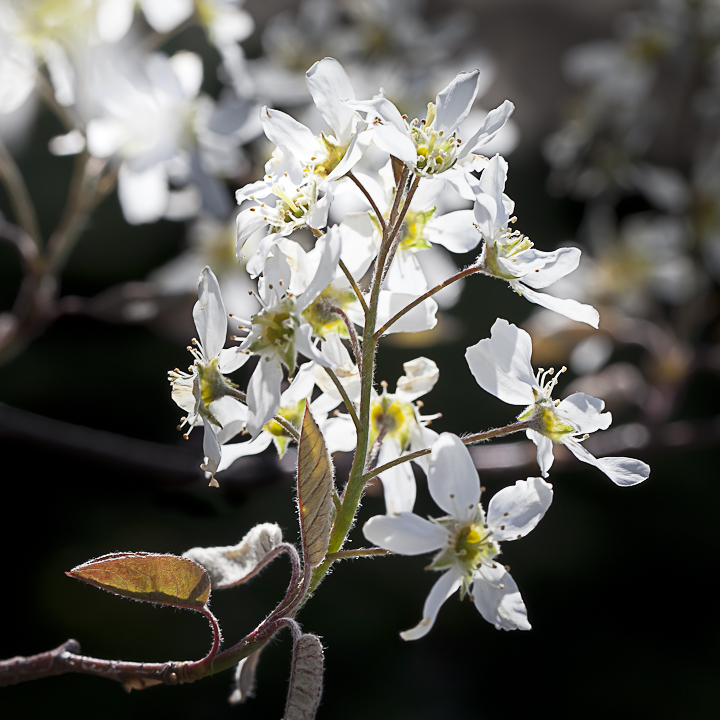
Serviceberry (Amelanchier spp.) is just one name for a diverse group of plants, most of which are native to North America. (Two Amelanchier species are native to Asia; another to Europe.) At least one species is native to every U.S. State, with the exception of Hawaii, and the common names - Shadwood, Shadblow and Shadbush (blooming when the Shad run), Serviceberry or Sarvisberry (the service for the dead who passed during the winter could be held when the plant flowered, as the ground was no longer frozen) and Juneberry (the plant bears early in the season, in June typically) - reflect their diversity. Another four-season performer, Serviceberry flowers early in the season, followed by early fruit set, a critical food source for many native birds. Fall foliage is dramatic, in yellow-orange to burnt orange hues. The delicately-striated bark shows to best advantage in this erect shrub of small tree during the winter. The tree is an important host plant for numerous native insects, including Red-spotted Purple and White Admiral butterflies. The fruits are also edible - and often delectable - for humans; make sure to pick the very darkest, ripest, sweetest of the fruit - best a handful at a time!

Salix discolor (Pussy Willow)
Probably the best known and most beloved of our early season shrubs is the Pussy Willow (Salix discolor), a classic harbinger of Spring often included in traditional Easter celebrations and used for cut flowers. (A new plant can often be started by simply pushing a newly-cut twig into the ground so several nodes are below grade.) Like many members of the Salix family, Pussy Willow as adapted to wetland conditions but will thrive in drier circumstances as well. It is a sizable plant, up to about 20 feet, and can get a bit leggy. The plant is named for the the soft, silky, silver-gray catkins borne on the plant before it leafs out, so they show to very best advantage. Like Spicebush, Pussy Willow is dioecious, with male and female plants. The male flowers turn yellow with pollen before fading; the fruit (borne only on the female shrubs) consists of a small capsule with tiny seeds embedded in a cottony down. Fall color is nondescript, with the leaves dropping early in the season and breaking down quickly into the soil The shrub's form is not exceptional but it does add some decent bones to the garden during the off season.

And, as everyone knows, my garden would not be complete without a Pussy Willow, although my cats' toes are much softer!

Wednesday, November 30, 2011

In Praise of Squirrels. Really.

Eastern Gray Squirrel (Sciurus caroliniensis)
Melanistic subgroup ("Black Squirrel")
Last week Monday I came home to what is, for me, a very upsetting situation: An animal in distress. A little black squirrel was in my back yard, moving lethargically and erratically, obviously disoriented and possibly seriously injured. As I approached it, carefully, it darted a short distance until it got tangled in some Clematis vines.

The squirrel was so beautiful - black fur soft and thick as the feathers of night, a dense, bushy tail; I was able to reach out and gently touch its haunch, so disoriented was it. It was obviously suffering from a recent injury or other affliction - other than its behavior, it was the picture of squirrel health. I called my vet, described the situation to the receptionist, who conveyed the details to the veterinarian on duty. I was told that, if I could capture the squirrel and bring it in, they could perform a humane euthanasia. Not being certain as to whether the little guy was simply injured or suffering from some neuropathic toxin, I opted to see if I could manage to get a hold of it and bring it in.

You know something is wrong when a middle-aged woman can actually catch a squirrel. It did bite me, through my gardening glove, but I managed to gently smother it in a large burlap sack and place it in a cardboard box. The little guy was quiet for the brief drive - I wondered if he'd had a seizure due to our encounter. I got him to the vet's office, where they took him back for evaluation. I later learned that he was so severely injured - probably due to a fall resulting in a closed-head injury, which is not uncommon this time of year - that the vet did elect to euthanize him.

Fox Squirrel (Sciurus niger)
I know, from informal surveys of some of the groups for whom I've spoken, that there are a lot of folks out there who don't particularly care for squirrels and would like them to just sort of "go away". I also know there are even people out there who think squirrels are so undeserving that killing them is actually a good idea, whether through the means of a firearm or a motorized vehicle or even poison. I have a slightly (actually, radically) different perspective on the situation.

It has been said that, before the "European Invasion" instigated by Christopher Columbus's landing in Hispanola in October of 1492, a squirrel could have traveled from the eastern bank of the Mississippi River to the Atlantic seaboard without ever touching the ground. The vast majority of the eastern half (this is a geographic/biological, not an arithmetic, term) of the United States consisted of diverse hardwood forest - maples, walnuts, beeches, oaks, hickories and chestnuts. Lots of chestnuts. In fact, 25 percent of all the trees in the eastern half of the United States were... American Chestnuts (Castenea dentata). Now, some tree seeds - including maples and elms, for example - can successfully germinate just sitting on the surface, sending out a small root to burrow into the ground and then sending up its first seed leaves. Other trees - including oaks, hickories and chestnuts - cannot successfully germinate unless their fruit is buried; their hard shells just aren't going to let that little rootlet get a start. And nuts and acorns can't bury themselves - they need someone to do that for them. That's where the squirrel - and some of its relatives - come into the picture.

Eastern Gray Squirrel
(Sciurus caroliniensis)
Here in Michigan we generally deal with three squirrel species. Sciurus niger, or the Fox Squirrel, is our largest squirrel, although a threatened subspecies (Sciurus niger cinereus, or the Delmarva Squirrel) native to the Delaware/Maryland/Virginia penninsula is larger still. The common name may be derived from their reddish coats, like those of red foxes. Next in size is Sciurus caroliniensis, or the Eastern Gray Squirrel. Usually mostly gray with some brown and a light underbelly, a melanistic subgroup is almost entirely black and found in certain geographic areas, including southeastern Canada. Finally, last but not least (except in size), is Tamiasciurus hudsonicus, the Red Squirrel, which is basically the Chickadee of Squirrels: Small package with lots of personality and not too shy about expressing itself. These guys are much smaller than our other native squirrels and are extremely territorial, easily intimidating their larger cousins.

A healthy forest is made up of lots of different plants that flower and fruit sequentially. From a squirrel's point of view, soft-bodied fruits (berries and such, which start bearing in June well into the fall) and soft-shelled seeds (think maple or elm here - the various species of which also fruit throughout the season) make great meals in the moment but they aren't very good for long-term storage. Squirrels bury hard-shelled nuts - which take much of the season to develop fully - in fall as their winter-time larder.

Tamiasciurus hudsonicus (American Red Squirrel)
Now, I realize that a lot of folks out there don't think squirrels are very smart. But they're plenty smart enough to get themselves through the winter, relying simply on what Mother Nature has provided. If you're depending on food you've stored to survive an otherwise very lean season, you're going to make sure you're putting up the very best quality food. In a squirrel's world, this means the very best nuts and acorns, healthy, undamaged fruit with the absolutely highest quality nutrition and caloric value. So, squirrels only bury the very best nuts. An aborted or borer-damaged fruit is not a good investment - too much work to find, bury and find again, for something that, in the long run, may not even really be that good for you. Squirrels can just "tell" an aborted acorn from a fully-ripe acorn or a borer-damaged walnut from a Grade AA walnut. How can they tell they're the best? I don't know. I do know that, if I want to tell a good acorn from a bad one, I have to get a bucket of water and see if they float or not (the good ones sink).

Eastern Gray Squirrel (Sciurus caroliniensis)
Anyone who has ever taken even a moment to observe squirrel behavior in the Fall also knows that the little guys never bury a nut where they find it. Some innate, inborn compass directs them to some unknown spot under a small pile of windblown leaves to bury that acorn or nut someplace else. Although there are large nut-bearing trees that are wind pollinated (including members of the Oak, or Quercus, genus), their fruit is obviously too heavy to be dispersed by anything significantly weaker than your average squirrel. Who carries the fruit away from the parent tree, further dispersing the plant's genetic material.

If you are only burying the very best nuts, and burying those nuts across a squirrel-wide territory, and you bury a lot more nuts than you're actually going to need and the nuts you don't need end up germinating, guess what kind of trees you're going to get? You're going to get the very best trees. And that is what we had here in the eastern half of the United States in 1492. All because of little rodents too many of us seem to despise.

It's true. Squirrels are not the edgiest of thinkers. They are very reactive, depending, in many instances, on the most primitive part of the brain - the amygdala (I call it The Squirrel Brain), where our fight versus flight responses are stored. But those little four-legged, fluffy-tailed squirrel brains have been able to figure out that the cars driving by under that oak tree are going to run over those acorns, and those acorns are going to make great meals today, saving energy that would usually be employed in getting those acorns open for burying even more nuts for wintertime; and they get mighty peeved if you just park your car there - minimizing their opportunities for fast food.

Tamiasciurus hudsonicus (American Red Squirrel)
So, the next time you find yourself grumbling about squirrel damage, consider the damage we've done to the squirrel's world in the last 500 years or so. Consider the fact that, although less than five percent of the entire eastern half of the United States hasn't been developed into cities and highways and farmland and golf courses, these little creatures have not only found a way to survive but to thrive. And maybe plant a nice oak or hickory so they'll focus on those nuts instead of your tulip bulbs. And plant those tulip bulbs with some hardware cloth over and around them to deter those digging squirrels. And slow down and let that little fluff ball figure out which side of the road he really wants to be on without you putting your trip to the grocery store ahead of his life.

Give a little respect.

All photos Deb Hall copyright.