Thursday, April 28, 2011

Deluxe Sunflower - Bubbles

One of the bugs that bit me late last year was returning to some fancier sunflower designs I had tried some years ago with some success.  I initially called them my "Extra Fancy" Sunflowers but that got rather cumbersome, so now I call them my "Deluxe" Sunflowers, reserving "Fancy" for the sunflowers I do with brightly-glazed petals.

My goal with the Deluxe Sunflowers was to come up with interesting applied textures.  The three original styles I had developed included "Pasta", using a mini extruder to apply an infinitesimal series of tiny tubes of clay to look like an entire carpet of stamens.  (I once did an entire series of five of these of various sizes for friends for Christmas; I swore off them for a while after that!)  I also used a star-shaped cake tip and slip to cover the flower's center, a much less exhausting process which worked quite successfully and I call "Cake".  Finally, I cut out 300-400 pieces of clay and rolled them into seed-like shapes and applied those for "Seed" in a process about a laborious as making "Pasta".  Yes, I do have a strong masochistic streak.

I was inspired by Amaco's Potter's Choice glaze series to explore this series further.  I really liked the rich tones of some of the earthier glazes, especially the Temmoku, which makes for a great sunflower center color, varying subtly on diverse textures.  In the last couple years, they've come out with some terrific colors, both brighter and more subtle; the former I'm been employing for my "Fancy" Sunflowers, the latter for the "Deluxe" series.

I featured my Deluxe Teddy Bear Sunflower earlier and there are now seven other designs in addition to Cake, Pasta and Seed.  This one, "Bubbles", uses the same technique as I used with "Cake" but with a large, round tip on the pastry bag with the slip.  I got these nice, big, round blots of slip, usually with a little peak in the center, which worked well with the Temmoku.  When I try these ideas out, I usually don't know for sure how it will evolve - this was a pleasing outcome for me.

In terms of the glazes I select, the piece seems to dictate that for me.  For some reason, this design wanted a brighter, lighter tone, so I selected Frosted Melon.  On a white clay body, as I think I've said before, this glaze is positively anemic.  On the peach stoneware I use, it really comes to life, going orangier where it's thinner and pooling to almost a pale yellow-green.

I hand-paint the center with at least two and sometimes three coats of Temmoku.  I then use wax resist over this, blotting - not brushing - it on so I don't pull away the glaze; I have a special jar reserved for these projects because it's difficult not to pick up a bit of the glaze in the process.  I let the piece sit for a couple hours (or put it under the furnace vent in the basement!) before I apply the glaze for the petals.  For smaller pieces - tiny, small and medium - I can usually dip the pieces in the glaze bucket.  For the larger pieces - large, extra-large and ginormous - I use a two-ounce ladle I found at Goldstar Products.  I typically do the back of the petals first and then the front, checking as I go to make sure I've gotten complete coverage,  I keep a number 3 or 4 brush handy to blot glaze into hard-to-reach areas between petals and a container of water and a small sponge to clean up drops of glaze off the center.

The pieces are fired on stilts, the number increasing with the size of the piece.  This can get tricky as some of these (especially Seed, Pasta and Teddy Bear) are pretty heavy - the more stilts you can fit around, the less likely you'll overwhelm a given stilt and have less salubrious results.

I was happy with this result.

Wednesday, April 27, 2011

Spring - Is Sprung? Finally?

I don't know about you but I'm thinking the winter of 2010-2011 is going to go down as one of those winters that just didn't want to give up.  My friend Theresa and I went up to Ubly (it's OK if you don't know where that is) on March 25 and it looked like Christmas up there - they had had a snow day two days before!  Crazy!  And the day we got in from Chicago, April 18, we were greeted with snow when we got up later in the morning, when we had to unload the truck.  My most indelible memory of late snow has to be 1983, though, when it snowed on April 30 in East Lansing.  So, it could be worse.

But, things are finally starting to warm up.  I can go outside in my garden in the morning and the evening and things look radically different.  So you know I'm going out there at least twice a day, right?  Just to see what's happened in the last 8-12 hours.  What's happening - and it's happening fast, now, between all the torrential rain, the gale-force winds and the sudden warming up - is that things are popping, budding, flowering, fading, some at record rates of speed.  So I got out there yesterday, between cleaning up the big central bed in the backyard, putting down five bags of mulch and pruning another 10-15% of my Clematis, and took a few pictures of some of the Spring flowers.

The first two pictures are of Sanguinaria canadensis, or Bloodroot.  I used to have some of the double form of this plant from my Mom but it died out and none the plants I dug from her garden before we sold the house seem to have survived - not even with the two friends with whom I shared them.  However, woodland wildflowers have an interesting habit of going dormant for a season when disturbed so I'll hold out hope for next year.  What I do have is the more common, and hardier, single form, which is quite lovely as well.  (The double looks like a miniature white water lily.)  This plant is a true harbinger of spring, with the flower rising up through the curled leaf, emerging, blooming and then withering.  Of the flowers in these pictures, all but one have already dropped their petals, all in a day or so.  So their beauty is as fleeting as it is fragile.  The leaf will continue to expand and unfold into a distinctive, deeply-lobed, roughly heart shape.  And then it will go completely dormant.  Why "Bloodroot"?  Because the plant's sap is a true red and was used in a number of functions by indigenous populations.  A friend has offered me the opportunity to collect some of the double form from her yard later this year, and I probably will.


The next two pictures are of Twinleaf, or Jeffersonia diphylla.  (The epithet in the botanical Latin literally translates as "twin-leaf".)  As William Cullina says in his authoritative work on wildflowers, capturing an image of this flower is not easy.  It is especially short lived, lasting no more than a day or two - which is interesting, as there cannot be that many pollinators floating around this early in the season.  (I saw my first bee on Sunday, so they are out there).  It started to look like it would flower on Sunday but it didn't warm up enough early enough in the day for it to really get going.  By Monday it showed itself a bit more but still did not open completely as conditions were not yet acceptable - it seems it isn't just a function of the amount of sunlight but also of the overall temperature.  Finally, on Tuesday, it opened completely, as you see here.  And by this morning all the petals had dropped.  So, I'm grateful to have been able to capture these images.  The plant persists after flowering, setting a small urn-shaped seed pod with a little lid, unlike any other seed pod I've seen.  It does spread modestly and makes for a nice ground cover of medium height.


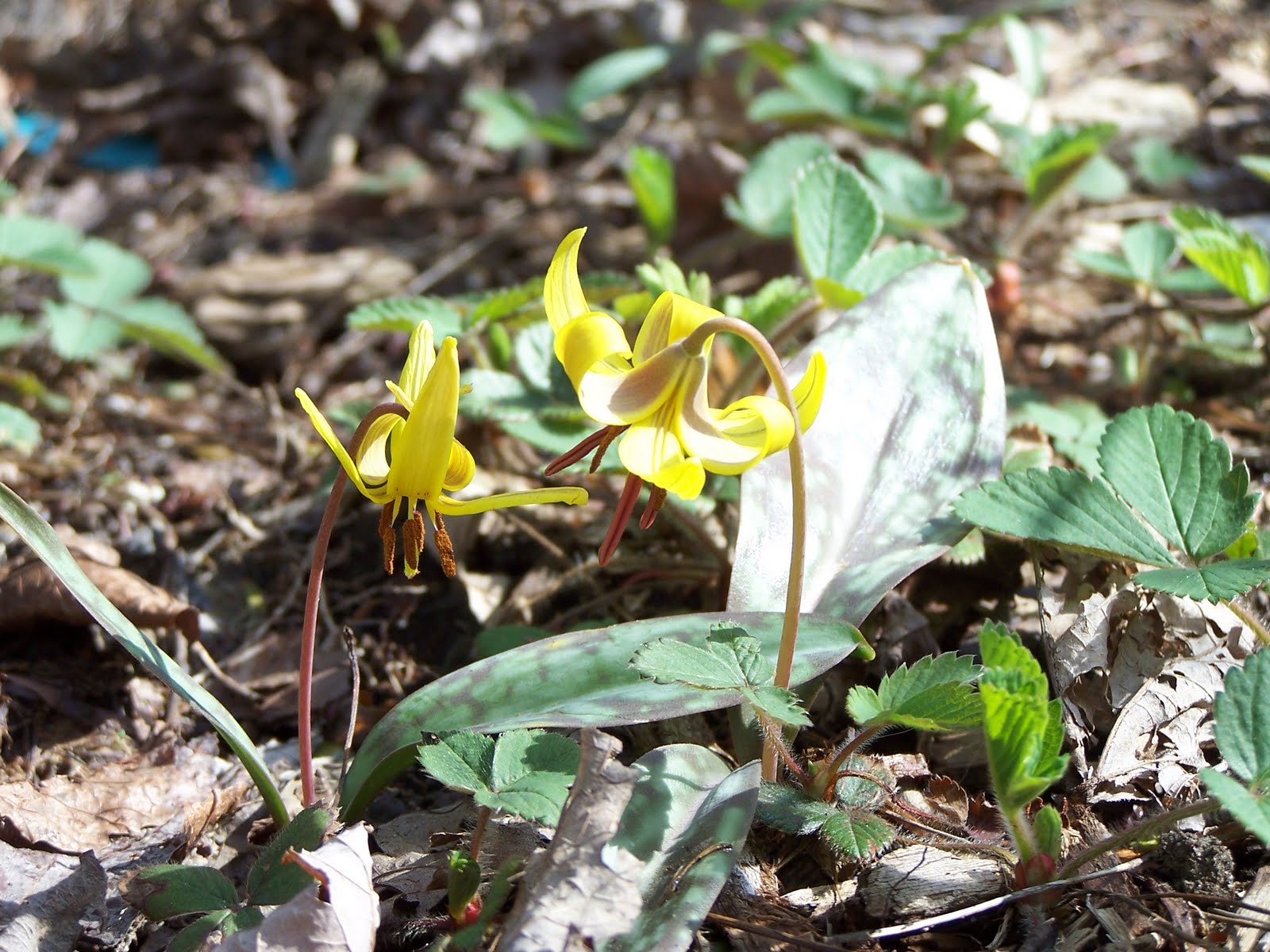
Finally, a picture of Erythronium americanum, or Yellow Trout Lily.  The members of this genus go by a number of names, including Fawn Lily (which, like "Trout Lily", refers to the mottling of the leaves) and Adder's Tongue, a reference to the seedpod with its projecting stamen.  There are two species native to the eastern United States, this being the more common; the other, Erythronium albidum, although less common overall, is quite common on Belle Isle here in Detroit and for a time, before the shrubs began to grow in after the deer were penned up, covered whole swathes of clearings in the woods near the racketball courts.  You can still see many of them there but they are losing some ground to the Spicebush and Drummond's Dogwood, among other species.  Like Mayapple, only mature plants - meaning those with two leaves - will flower.  I had dug these from a friend's property in Macomb Township last Spring, so you can imagine my delight when I had not one, but two flowers this Spring.  (Some lummox of a squirrel broke the smaller one off sometime today.)  These plants have a tendency to pull themselves lower into the ground, preventing flowering; the strategy is to lay a slab of rock about 5-6 inches below grade and then planting above so they don't have the chance to do that.  So, I'll be digging these guys up (again) and planting them again accordingly, in hopes that we will have flowers again next year (and maybe the next).

Lots of great events coming up.  We have the final line-up for the Garden Tours on June 4 and August 20 (10:00am-2:00pm) and will be featuring the art of Black Cat Pottery, Notable Greetings, Farmbrook Designs and Bird Homes by Tim.  My friend Stephen Hulbert of Hulbee will be providing refreshments - so we're going to have a great time!  Look for updates on the events here and on my Facebook page.

It's raining.  Again.

Saturday, April 2, 2011

Fancy Sunflowers 1

Ginormous Fancy Sunflower, Melon
Don was over on Thursday, March 31 (my birthday) to shoot my new Fancy Sunflowers.  After I got over my obsessive invention and production phase with the Deluxe Sunflowers (see the Teddy Bear Sunflower entry of November 30, 2010, the subject of which, by the way, was in the Green Show at the Grosse Pointe Art Center, which closed today), I started thinking of other ways to take the sunflowers to a new level.  I chose a number of the more highly relieved textures I have been using in my original sunflowers and decided to glaze the centers with the Amaco Potters Choice Temmoku glaze, as I had done with the Deluxe Sunflowers, and use really bright, jewel-tone glazes from that same series and from my own recipes for the petals.  The results are as you see here.

I only did these in the Medium, Large, Extra Large (a new size, with this series, based on the Vegetable Bowl from my stoneware dishes set, Sasaki's Colorstone, no longer in production but available through Table Tops, Etc. and other on-line replacement retailers) and Ginormous.  Although they're very distinctive, I felt that they could be "lost" in the landscape if they were too small - especially as I wanted the textured centers to be really distinctive.

Ginormous Fancy Sunflower, Turquoise
As with the original sunflowers, I find myself associating certain petal "colors" with certain center textures.  The center of the Large Frosted Melon sunflower above is achieved by dropping the clay slab on a bamboo placemat I purchased at Pier 1 (a great place to haunt for texture sources, as are the clearance areas at Joann's and Michael's - funny; maybe those two should meet...).  The flower pattern of the placemat "wants" yellow petals.  The Medium Lace Sunflower (left) is finished with Textured Turquoise.  Indigo Float (below, Extra Large Sunflower) is one of my students' favorite glazes, as well as one of mine.  It really sets off the bubble wrap texture, which looks completely different when glazed as opposed to the Burnt Umber stain I use on my original sunflowers.  The other colors I'm using include Chun Plum,  Lustrous Jade, Vert Lustre, Toasted Sage (like Frosted Melon, utterly anemic on white stoneware but quite interesting on the red), Deep Sienna Speckle (all Amaco Potters Choice) and my own Dark Slate.

Ginormous Fancy Sunflower, Indigo
The most important criteria I had for the glazes I selected was that they had to "break" over the edges of the petals.  This means that, where the glaze thins over edges as it become vitreous, takes on a different color, often influenced by the clay body underneath.  By working with a higher-iron-content body, more intense variations can be achieved.  I did two series of lace bowls - in red and white stoneware - comparing some of the glazes and found the white stoneware series, well, frankly insipid.  The red series was much more interesting and visually complex as the glazes broke over the relief created by the lace impressions.  That's carried over well into this series of sunflowers.


Don used the same set-up as we used back in January - we seem to have this down, and it really helps unify the presentation of my work.  We can slap it together pretty quickly now and just "shoot away" - I'll clear the work table and organize the pieces to be shot and assist him in moving them through the set.  The different sorts of lights he's using - one with a sparkly background the effect of which you can see on the right side of the flowers - really bring out the depth of the textures I'm using as well as the glossiness and colors of the glazes.  He'll hopefully be coming again sometime next week to shoot some of the Deluxe Sunflowers that are now coming out of the kilns - which are looking pretty damned fine, if I do say so myself - as well as the straggling Fancy Sunflowers.  I'm thinking all of these will do well in Chicago - they're certainly very rich from a design standpoint, the Deluxe Sunflowers reminding lots of folks of expensive chocolates, whereas the Fancy Sunflowers are more "flowery", which we really need with this Winter that just won't let go.

Monday, March 21, 2011

Leaves - Lots of 'em

I know, I know - Where the heck has she been?  Do you really want to know?  OK, well, then, everywhere from Midland to East Lansing to Kalamazoo to Taylor.  That's where.  And this week it's Ubly (that's south of Bad Axe - oh, never mind!)  Yep, I've been on the road a whole lot and will be for a lot of the growing season.

So I'm behind.  Let's see if I can start getting caught up.

Going back to the shoot Don and I did at the end of January, we shot a couple images of some redbud (Cercis canadensis) leaves with which I was working.

Although I'm inclined to look for perfect leaves, I also realize recognize that a leaf with some insect damage tells a story.  Leaf cutter bees seem to really like my redbud, so I do sometimes include leaves that have distinctive insect damage (leaf gall on oaks is pretty cool to work with).  What I wanted to do was create an image of an individual leaf that was absolutely resolved.  I used the same technique I used for the leaf wall pockets, rolling out a relatively thinner slab of clay, using a metal kidney and then rolling with the rolling pin to remove the canvas texture.  Then I would roll in the leaves - either fresh or moistened fallen leaves (with these last, make sure you've blotted them pretty dry or they stick to stuff in the ugliest way).  Using my very sharp (and I mean it's sharp!) cutting tool, I cut the leaves out.  Using some shallow bowl-shaped molds, I push the clay in to create some shape - so it isn't just flat.  Let the piece dry, peel off the leaf and use a piece of synthetic steel wool too "soften" the edge.  The pieces are then bisque fired (they can be stacked).

Glazing is pretty simple.  I stain the top surface to bring out the pattern of the leaf's veins, apply wax resist, then allow it to dry completely.  Then I glaze the bottom and the edge, preferably by dipping or pouring the glaze.  I fire the pieces upside down on a post so there are no stilt marks - making for a piece that folks cannot help but pick up, turn over and over and touch.

We started the bird bowl workshop at Firebrick Gallery in Rochester last week - the fabrication session went really well and we're thinking about doing another workshop on wall pockets, if there's enough interest.

The gardening season is starting - had two garden evaluations today.  Can't wait to get out in my own yard!

More on upcoming events in future posts!

Keep well and enjoy the warmer weather.


When Don and I were shooting the pieces we had a lot of help - especially from Rameses, as you can see if you look closely at one of the photos.

Friday, March 4, 2011

Staff: Cheryl M. English

Don was over again this weekend, doing some head shots of the single staff person with Black Cat Pottery (that's me, by the way).  We had a pretty good time but I have a new appreciation for how boring it must be work in films - lots of sitting around, waiting for the lighting to work, for the extras (in this case, members of the Management Team) to settle down, get the camera positioned correctly and only then realizing we need a different lens.  Rameses and Princess Nur were not really interested in the entire process; Dora and Alex really conveyed different personalities; especially Dora - she looks positively FIERCE!

But here we are - I'm only putting in a three because I see more than enough of myself in the mirror in the morning.

Heading out to Midland this afternoon for Dow Gardens Know & Grow after I finish my speaking engagement with Grosse Pointe Shores Garden Club (always a delightful group of ladies); then down to East Lansing for Wildflower Association of Michigan.  A quick stop home to make sure the place hasn't burned down and back up to EL for Michigan Herb Associates.  Good thing my friend Jeanne (known as "Auntie Jeanne" to the Management Team) can hang with them while I go make a living.

Don't forget about the upcoming Hanging Birdbath Workshop at Firebrick Gallery in Rochester, MI.  Check out their link at the bottom left of this page.

Hope to see you soon!

Sunday, February 20, 2011

Management Team, Part VI: Doni

Doni, or Adonis, is Dora's brother.  We're not actually certain of the genetic reality of this, although some of her markings are exactly the same color and pattern as his and their gait is very similar; regardless of the biological facts, they came into the family at exactly the same time from the same place and are the same age, so what else would they be?

His is the longest tail I've had on a cat, which means he's got long legs, too.  He's probably rangier than Rameses but not as bulky.  Doni is definitely a very photogenic fellow and, like most cats (which are amongst the most self-aware animals with whom I am acquainted) he knows it; but he's not hung up on himself.  He's actually quite an affectionate guy and probably the most relaxed personality we've had in the house in quite a while - maybe in forever.  Doni is the antithesis of Meli - very little gets him going; he's very engaged in what's going on in the house without having to get into every little thing all the time.  Where Dora gets wound up about the birds, Doni can become a bit (for him) excited when there's a squirrel in his yard.

He is extremely attracted to food.  All kinds of food.  He has been known to attack containers of quick oats, and bagels, and granola bars.  So he apparently has a special taste for carbs.  We do keep him on a strict diet as we don't want his long, lean frame to run to fat.

All around, Doni's a pretty special guy.  Which is why I sometimes tell him he's downright "adonishing".

Sunday, February 13, 2011

Management Team, Part V: Dora


This is Pandora Grace Diane, or "Dora" for short.  She came into our lives about 1-1/2 years ago, back in July 2009.  I had lost Gus and Isis within less than 10 days of one another the previous March and had thought I might get a kitten or two the next Spring.  I had a speaking engagement at Stone Cottage Gardens in Gladwin, Michigan, run by my good friends David and Mary Moore.  They have a lot of outdoor kitties that folks have dumped on their property; they do the best they can (they're both deadly allergic) in terms of feeding and vet care, but it's a challenge.

Back in July 2009, they had had a number of litters and Dora was among the kittens.  I actually met Doni, whom you will meet next week, first, but it was Dora to whom my heart went out.  When I met her, aged about seven weeks, she had a severe upper-respiratory infection, with her entire nose caked with mucus so she couldn't smell anything, and so was not eating particularly well.  I spent some time cleaning her up and treating her with some silver nitrate Mary had on hand but she was very sad nevertheless.

I decided I would take a kitten home.  But to decide between Dora and Doni was difficult, if not impossible.  Then I thought about the environment from which they were coming - highly social, outdoors, in the country -  and the one to which they would be going (especially as they would both have to be quarantined until their health stabilized)  - isolated, indoors, in the city; I decided to take them both.  My friend Theresa Dearhamer had made the trip up to Gladwin with me; she had the dubious privilege of carrying the two kittens in their carrier on her lap all the way back to the Detroit area.

The "kids" went to the vet on Monday, two days later, and we started to treat them.  Interestingly, although they had prize-winning ear-mite infestations, neither had any fleas.  The upper-respiratory infections were the biggest challenge, especially with Dora, but they both began to recover and then flourish.  When I let them out of their "room", Dora was the first to begin exploring, so I named her Pandora.

She is also the sweetest cat I've ever known.  It seems impossible for her to do anything that is not adorable, including (believe it or not) having a hairball.  So, I named her "Grace" as well, for her grace of spirit.  And she is a great hunter (she brings the mousie back to me so I can throw it again - when we play "Throw" - "Fetch" is a *dog* game) - so I named her Diane as well, which also happened to be my Mother's name.

Because Dora *is* so adorable, we have added a new word to the English language:  "Pandorable".  And she is, thus far, universally acknowledged to be so.